
Essential Spanish Phrases for Traveling in South America
7 February 2026
The Gringo Trail: 10 Things
14 June 2026
Guía de Spanish Latin America para Viajeros
Imagine arriving in Quito, Bogotá, or Buenos Aires convinced your Spanish is good enough. You've studied, watched TV series, maybe even taken classes. And then someone says, "Vos sabes," and you stare blankly because you've never heard that "vos" in class.
Or you ask for something at a market using a word you learned in another country, and the person gives you a strange look.
Welcome to Latin American Spanish: it's not just one variant, it's a universe that changes from country to country, from coast to highlands, from city to town. Understanding Latin American Spanish before traveling isn't an academic luxury; it's what separates the traveler who adapts quickly from the one who spends their first few days lost. This article exists to make that moment of confusion as short as possible. Here you'll understand the real differences between the major varieties of Latin American Spanish you'll encounter while traveling through the region: pronunciation, grammar, vocabulary, and the words that can get you into trouble if you don't know them.
And if you want to arrive already calibrated, La Escuelita Spanish School Montañita, in Ecuador, has been working for years with travelers who are looking for exactly this: to speak the Spanish spoken on the streets of Latin America, not the one that appears in textbooks.

Why Latin American Spanish surprises the European traveler
The differences aren't just about accent. They're real differences in pronunciation, grammar, and everyday usage that directly affect your ability to communicate from day one. Knowing about them in advance completely changes the experience of arriving in a new country.
Seseo: a single pronunciation for three letters
Throughout Latin America, the "c" (before e, i), the "z," and the "s" all sound exactly the same: like an "s." This is called seseo and is the feature that unites more than 300 million native speakers of Latin American Spanish on the continent. For someone who learned Spanish in Spain, where the "c" and the "z" have different sounds, this sounds uniform at first. For someone who learned using a peninsular method, it's the first phonological adjustment that needs to be made. It's not incorrect: it's the norm for most of the Spanish-speaking world.To know more about us:
The disappearance of "you" and the rhythm that changes everything
In Latin American Spanish, "vosotros" is practically nonexistent in the everyday speech of any country,
in any common register. Its replacement is "ustedes," both when speaking with friends and in a
formal meeting. For the Spanish traveler, this is a minor change, but for those who learned with a
standard European method, it means relearning the conjugation table.
Besides vocabulary, the rhythm of speech is the first thing that strikes the ear. Caribbean Spanish is
fast, the consonants are softened or disappear, and the flow is musical and rapid. Andean Spanish, on the other hand, is more deliberate and articulated, with each syllable clearly marked. This difference in speed and
cadence, visible, for example, when comparing a conversation in Havana with one in Quito, means that
two speakers of Latin American Spanish can sound almost like different languages to an untrained ear.
The major dialectal zones of Latin American Spanish
You don't have to be a linguist to understand the regional differences in Latin American Spanish. It's enough to know the most recognizable features of each region before you arrive.
🎓 Teacher Tip:
👉 Download my free list of important phrases in Spanish to learn how each South American country uses them.

The Caribbean, Mexico and Central America: speed and cadence
Caribbean Spanish, which includes Cuba, Puerto Rico, the Dominican Republic, Venezuela, and northern Colombia, is characterized by the aspiration of the "s" at the end of a syllable: "casas" sounds more like "cahah."
Some words sound incomplete to the unfamiliar ear. Mexico, with 133 million native speakers, the country with the most Spanish speakers in the world, has a more conservative pronunciation but an intensive use of diminutives that turns almost any noun into a term of endearment. In Central America, everyday speech incorporates vocabulary of indigenous origin: Mayan loanwords in Guatemala and Nahuatl vocabulary in parts of Mexico and El Salvador are concrete examples of this mixture.
El español andino y el cono sur: los dos extremos del espectro
The Andean Spanish of Ecuador, Peru, Bolivia, and the interior of Colombia has Quechua influence, is articulate, and relatively accessible for someone wanting to build a solid foundation. Its clear pronunciation and unhurried rhythm make it a recommended starting point for learners of Spanish as a foreign language. At the opposite extreme, in terms of phonetics and intonation, is the Rioplatense Spanish of Argentina and Uruguay: the "y" and "ll" are pronounced like "sh" or "zh," and the intonation has very marked peaks in stressed syllables, giving it that unmistakable rhythm that everyone recognizes. Knowing both varieties gives you a compass to orient yourself at any point in between on the continent.
Latin American Spanish grammar in everyday speech: vos, tú, and the past tense
La gramática de manual y la gramática de la calle no siempre coinciden. Hay dos diferencias que vas a encontrar en carteles, menús y conversaciones reales, y que conviene entender antes de llegar. Dónde se dice "vos" y cómo conjugarlo El voseo no es un error ni un arcaísmo curioso: es la norma cotidiana en Argentina, Uruguay, Paraguay, Costa Rica y en partes de Colombia, Bolivia y Ecuador. Se estima que dos terceras partes de la población latinoamericana vosea en algún contexto. Las conjugaciones difieren del tuteo: "tú tienes" se convierte en "vos tenés", y "tú eres" en "vos sos". En imperativo: "hablá", "comé", "vení". Si lees un menú en Buenos Aires que dice "pedí tu plato favorito", no es un error tipográfico: es voseo en imperativo. Reconocer estas formas evita confusiones reales tanto en la lectura como en la conversación. Si quieres profundizar en la historia y distribución del voseo, existen recursos académicos y entradas enciclopédicas que lo detallan.
Why does the preterite tense predominate in most Latin American countries?
In Spain, it's natural to say "I haven't had breakfast today" or "I went to the bank this morning." In most of Latin America, the standard form for the same message is the simple past tense: "I didn't have breakfast today," "I went to the bank this morning." The present perfect tense exists, but in most countries it's reserved for very specific contexts or avoided in everyday speech. The exception is the Andean region: Colombia, Ecuador, and Peru maintain the present perfect tense more frequently than the rest of the continent. For those learning Latin American Spanish, this represents a real simplification, a clear verb form for the past, without ambiguity about which one to use.
What Can Confuse You or Save You
Language is where the differences become more concrete and more fun, but also where the most memorable misunderstandings can arise.
Everyday Words That Aren't the Same Everywhere
When talking about transportation, "carro" works in Mexico, Colombia, and Venezuela; "auto" in Argentina and Chile;
"coche" in Spain. "Guagua" is the bus in the Caribbean, but in Ecuador and Chile it's an affectionate word for baby. "Plata" isn't just the metal: throughout Latin America it's the common way to say "money."
"Fósforo" replaces "cerilla" for matchsticks. And "pararse" in Latin American Spanish means to stand up, not to stop, as a Spaniard might assume. These differences appear at the market, in restaurants, in taxis, and in hotel instructions.
Free resources to start calibrating your ear
Consuming Latin American Spanish content before traveling makes a real difference in adaptation.
Series, music, podcasts, and films from different countries familiarize you with the rhythm and vocabulary of each region. For intermediate travelers preparing to explore Latin America, my Survival Spanish LATAM podcast, available on Spotify and Apple Podcasts, is a practical and focused tool. It is produced by me, Gaby Estrella, founder of La Escuelita Spanish School Montañita, with 18 years of experience teaching Spanish in travel and tourism contexts. It is specifically designed to help you communicate naturally in everyday Latin American situations, not to prepare you for an exam. Additionally, if you want a clear guide to the main differences between Spanish from Spain and Latin America, there are reference resources that summarize the most relevant features.
Why Classes with a Native Speaker Make All the Difference
No app can simulate a real conversation with cultural nuances, local slang, and the speed
you'll encounter on the street. Classes with a native speaker trained in teaching for travelers
accelerate this adaptation process in a way that self-study can't replicate. At La
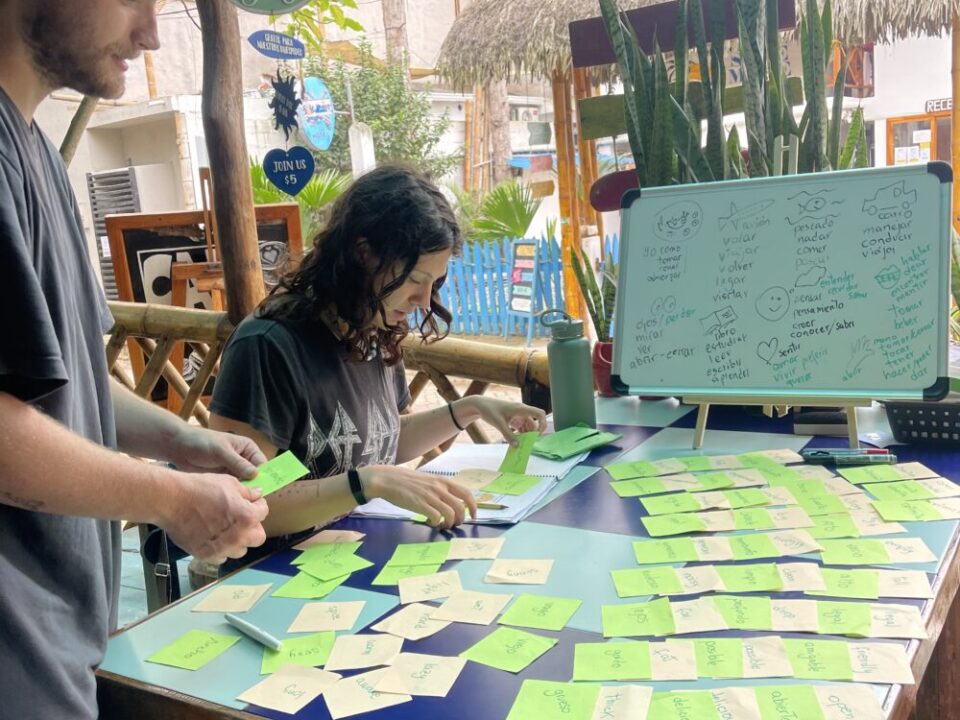
Escuelita Spanish School Montañita, in-person classes include simulations of real-life situations:
markets, transportation, conversations with locals, and negotiations for accommodations. Online courses
allow you to prepare before arriving in the region without sacrificing personalization or a communicative approach.
If you're looking for practical phrases to use from day one, check out our essential Spanish phrases for traveling in South America.
Before you pack your suitcase, tune your ear. Latin American Spanish isn't a labyrinth.
Understanding seseo, recognizing voseo where it appears, and knowing that vocabulary varies by country already gives you a real advantage over most travelers who arrive without that preparation. You learn the language on the street, in conversation, from the mistakes someone kindly corrects. Before you leave: consume Latin American Spanish content, practice with native speakers, and choose resources designed for travelers, not for passing exams. The Survival Spanish LATAM podcast, La Escuelita's online classes, or their in-person programs in Montañita are concrete, not generic, starting points. The goal was never to speak perfectly: it was to communicate confidently from the first day you set foot on Latin American soil.
Final Thoughts: Tips to Sound More Natural When Speaking Spanish
From my experience teaching Spanish in Ecuador:
-
Speak slowly — clarity matters more than speed
-
Don’t worry about mistakes — communication is the goal
-
Smile — it helps more than perfect grammar
-
Listen to how locals speak
-
Focus on real Spanish, not textbook Spanish
Living in Montañita has taught me that Spanish is best learned in a relaxed, real-life way — just like enjoying the beach and talking with locals.
✅ Ready to Take the Next Step?
👉 Download my free phrase list for travelers
👉 Join our online or in-person Spanish lessons (we’re in paradise!)
👉 Follow us on Instagram for daily Spanish tips, fun games, and travel inspiration
👉 Listen my Podcast totally for free!
¡Vamos! Your Spanish journey starts now.


 EN
EN  DE
DE